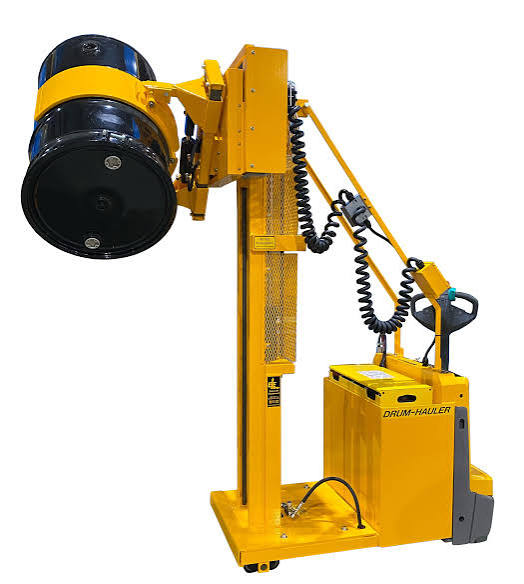
People lift heavy drums as a part of everyday operations in many workplaces across Australia. Drums can be challenging to lift, tip, and/or pour out safely, regardless of whether they contain chemicals, oils, food ingredients, or industrial liquids. When drums require turning or pouring, all this causes manual handling, putting employees at a risk of strains, spills, and workplace injury.
Enter the drum rotator, which is designed to reduce risks by enabling operators to easily lift, rotate, and position drums. We look at five common applications where this equipment minimises manual handling risk.
-
Chemical Manufacturing
Chemical plants routinely dispense stored liquids from steel or plastic drums. Most of these need to be handled in order to avoid spills and exposure.
Operators are no longer required to tip the heavy containers manually; even one person can rotate drums in a smooth and accurate manner with a drum rotator. The regulated motion not only offers a higher level of safety but also helps in maintaining an even product transfer.
Moreover, several classifiers are now supplementing these drum accessories by providing other top-notch solutions for safe transport, dispensing and storage in offices around the workplace.
-
Food and Beverage Processing
In the food manufacturing world, its normal to store ingredients such as syrups, edible oils, flavourings and fluid concentrates in bulk drums. Manually lifting and pouring the drums is physically taxing; however, if spilled, they can also compromise hygiene standards.
The drum rotator also provides dispensers with improved accuracy while reducing the need to physically strain themselves. This helps in keeping areas irrespective of production clean and efficient work-in-progress flow.
-
Warehousing and Distribution
Warehouses receive, store, and ship thousands of drums containing every product under the sun. Container rotation exists when an order is being prepared for fulfilment or a drum is positioned on the floor to move material.
Without the right tools, workers tend to use awkward manual methods that raise risks of injury.
Combination of custom handling equipment together with compatible drum accessories enables warehouse personnel to handle such duties in a safer manner while also increasing efficiency.
Using the right kind of equipment also prevents product damage during normal handling.
-
Oil and Lubricant Facilities
Drums of lubricants, hydraulic fluids, and oils are commonly handled in automotive workshops, mining operations, and industrial maintenance facilities.
Partially emptied, these heavy drums are even more difficult to manage since the sloshing fluid can upset the balance of the drum in movement.
A drum rotator offers controlled rotation during dispensing, providing a safe way to empty the drums with minimal lifting and awkward twisting of the body.
This increases safety at the workplace while also helping in reducing product waste and usage.
-
Waste Management and Recycling
Manipulation of waste materials normally includes transferring fluids, especially restricted chemicals or recycled products contained in drums.
That said, you must operate very cautiously to reduce spills and environmental risks.
Common tasks include:
- Emptying waste liquids
- Rotating collection drums
- Transferring recyclable materials
- Managing hazardous waste containers
- Preparing drums for disposal
Operators can perform these actions with increased stability while reducing the physical strain required through use of a reliable drum rotator.
Using proper drum accessories, it can also create safer handling methods to meet both operational and compliance requirements at the private enterprise.
Final Thoughts
Heavy drums are a solution to what manual handling problem we uniquely have at many industries. In various industries like chemical manufacturing, food production (processing), warehousing, oil transportation and waste management, this technology is used to decrease manual labour handling and hazards while enhancing safety as well as operational efficiency.
Speciality drum handling equipment, paired with appropriate accessories, can eliminate manual lifting of drums, provide superior control during product transfer and ensure a safer work environment for staff. That is why investing in purpose-built solutions is a tangible way to mitigate risk at work and maintain pace of operations.